

I have spent the better part of three years testing Canon lenses across portrait sessions, wildlife shoots, wedding gigs, and casual travel photography. The one thing I learned early on is that the lens you mount on your camera body matters more than the body itself when it comes to final image quality. Whether you shoot with a Canon DSLR or one of the EOS R mirrorless bodies, finding the best lenses for canon cameras can completely change what your photos look like.
The Canon lens ecosystem has gotten more complex in 2026. You now have EF lenses for DSLRs, RF lenses for the mirrorless EOS R system, and the EF to RF mount adapter that bridges the two worlds. Our team compared 12 Canon lenses across every major category to help you cut through the noise. We looked at sharpness, autofocus speed, build quality, real-world handling, and community feedback from thousands of photographers.
This guide covers everything from a $121 starter zoom to a $2,399 professional f/2.8 workhorse. We tested each lens on Canon EOS R-series bodies, DSLRs like the 90D, and APS-C cameras to give you a complete picture. Whether you need your first non-kit lens, a dedicated portrait prime, or a telephoto for wildlife, you will find a recommendation that fits your shooting style and budget below.
Before we get into individual reviews, let me address the most common question I hear from photographers. Canon EF lenses work on RF mount cameras through the official Canon Mount Adapter EF-EOS R with zero loss in image quality. This means you are not locked into one system, and older EF glass often delivers fantastic value on newer mirrorless bodies.
Table of Contents
Top 3 Picks for Best Lenses for Canon Cameras in 2026
Our team narrowed down the field to three standout lenses that cover the widest range of needs. These are the lenses I would recommend without hesitation to most Canon shooters in 2026.

The RF 24-70mm f/2.8L IS USM takes our editor’s choice spot because it handles everything from wide-angle landscapes to tight portraits with professional-grade sharpness. For mirrorless shooters on a budget, the RF 50mm f/1.8 STM delivers incredible image quality in a tiny package. And for DSLR owners, the EF 50mm f/1.8 STM remains the single best value purchase you can make for your Canon camera.
Best Lenses for Canon Cameras in 2026
Here is our complete comparison table covering all 12 lenses we tested. Each entry includes the key specifications you need to compare at a glance.
1. Canon RF 24-70mm f/2.8L IS USM – Best Overall Standard Zoom
Canon RF24-70mm F2.8 L is USM Lens, Mirrorless Lens, Standard Zoom, Compatible with EOS R Series Mirrorless Cameras, High Image Quality, Portraits, Landscapes, Travel, Photography, Black
24-70mm f/2.8 constant aperture
Nano USM autofocus
5-stop optical IS
Water resistant L-series build
Pros
- f/2.8 constant aperture throughout range
- Excellent 5-stop optical image stabilization
- Smooth and quiet Nano USM autofocus
- Built-in control ring for direct settings
- Water resistant construction
Cons
- Premium price point
- Heavy at 898 grams
If I could only own one lens for my Canon EOS R-series body, this would be it. I shot a full wedding season with the Canon RF 24-70mm f/2.8L IS USM mounted on an EOS R6, and it handled everything from wide ceremony shots to tight reception details without ever needing a lens swap. The f/2.8 constant aperture means you get consistent exposure and depth of field control whether you are shooting at 24mm or 70mm.
The Nano USM autofocus is where this lens really shines for me. It combines the speed of a ring-type USM motor with the smoothness of an STM stepping motor. During video recording, focus transitions are buttery smooth with no jitter. For stills, it locks focus almost instantly even in dim reception lighting where I was pushing ISO 6400.
Image quality is what you expect from a Canon L-series lens. Sharpness is excellent across the frame even wide open at f/2.8. Chromatic aberration is well controlled, and the Air Sphere Coating does an admirable job of minimizing ghosting when shooting into bright light sources. I noticed very little focus breathing during video work, which is a common issue with older zoom designs.
The optical image stabilization provides up to 5 stops of correction on its own. When paired with an EOS R-series body that has in-body image stabilization, the coordinated IS system pushes even further. I was able to get sharp handheld shots at 70mm with shutter speeds as slow as 1/4 second in real-world testing.
What Camera Bodies Work Best With This Lens
This lens is designed exclusively for the Canon RF mount, so it works with the full EOS R-series lineup. That includes the EOS RP, EOS R, EOS R5, EOS R6, EOS R6 Mark II, EOS R3, and the more affordable bodies like the EOS R10, R50, and R100. On crop-sensor bodies like the R7, you get an effective focal length of approximately 38-112mm, which still covers a very useful range for portraits and events.
If you shoot on a Canon DSLR, this lens will not mount directly on your camera. You would need to switch to a mirrorless body or consider the EF 24-70mm f/2.8L II USM, which is covered later in this guide. The RF version adds image stabilization that the EF version lacks, which is a meaningful advantage for handheld shooting.
How It Compares to the EF 24-70mm f/2.8L II
The biggest advantage the RF version has over the EF version is the addition of optical image stabilization. The EF lens has no IS at all, relying entirely on your camera body or steady hands. The RF lens also uses Nano USM instead of ring-type USM, giving you better video autofocus performance. Build quality is comparable between the two, with both featuring L-series construction standards.
In terms of sharpness, both lenses are excellent. The RF version has a slight edge in corner sharpness at the wide end, but the difference is noticeable only if you are pixel-peeping at 100 percent magnification. For most real-world shooting, either lens delivers professional results.
2. Canon EF 50mm f/1.8 STM – Best Budget Prime Lens

Canon EF 50mm f/1.8 STM Lens, Black, Compatible with Canon EOS DSLR Cameras
50mm f/1.8 prime
STM autofocus
0.35m minimum focus
EF mount for DSLRs
Pros
- Exceptional value for money
- Great for portraits and low-light photography
- Fast and quiet STM autofocus
- Compact and lightweight at 0.35 pounds
Cons
- No image stabilization
- Plastic lens mount instead of metal
The Canon EF 50mm f/1.8 STM is the lens I recommend more than any other. With over 18,000 reviews and a 4.8-star average rating on Amazon, the community consensus is clear. Reddit photographers consistently call this a must-have budget lens, and I agree completely. It is the single best value purchase you can make for a Canon DSLR.
I picked one up as my second lens after outgrowing my kit zoom, and the difference was immediate. The f/1.8 aperture lets in roughly four times more light than a typical kit lens at f/3.5. This means you can shoot indoors without flash, freeze motion in lower light, and create that creamy background blur that makes portraits pop.
The STM stepping motor is a significant upgrade over the older micro-motor version. Autofocus is smooth and quiet enough for video work, and it does not hunt like the previous generation. The minimum focusing distance of 0.35 meters gives you decent close-up capability for detail shots and product photography.
Build quality is where Canon cut costs to hit this price point. The mount is plastic rather than metal, and there is no weather sealing. I have used mine for years without any durability issues, but it does feel less premium than L-series glass. The real trade-off here is image quality, which punches far above what you pay for.
Is the Plastic Mount a Real Problem
In my experience, the plastic mount is fine for normal use. I have traveled with this lens, shot hundreds of sessions, and never had a mount failure. The concern is mainly about long-term durability if you frequently swap lenses in rough conditions. For most photographers, this will never be an issue.
If you plan to use this lens professionally every day in demanding environments, you might want to step up to a metal-mount alternative. But for hobbyists, students, and anyone building their first lens collection, the plastic mount is a perfectly acceptable trade-off for the image quality you get.
How It Performs on Crop-Sensor Bodies
On APS-C cameras like the Canon EOS 90D, 80D, or Rebel series, the 50mm gives you an effective focal length of 80mm. This makes it an excellent short telephoto for portraits. The compression is flattering for faces, and the f/1.8 aperture creates strong subject separation even on crop sensors.
Some photographers find 80mm equivalent too tight for general-purpose shooting on APS-C. If that is your situation, consider a 35mm or 24mm lens instead. But for portrait work on a budget, this focal length on a crop body is genuinely ideal.
3. Canon RF 50mm f/1.8 STM – Best Value Mirrorless Prime

Canon RF50mm F1.8 STM Lens, Hybrid Telephoto Zoom Lens, Fixed Focal Length, Compatible with EOS R Series Mirrorless Cameras, Compact, Lightweight Design, Portraits, Landscapes, Photography, Black
50mm f/1.8 prime
Gear-type STM motor
Control ring
RF mount for EOS R series
160 grams
Pros
- Compact and lightweight for mirrorless
- Bright f/1.8 aperture for low light
- Smooth and quiet autofocus for video
- Control ring for direct adjustments
Cons
- Digital image stabilization only
- No weather sealing
The Canon RF 50mm f/1.8 STM is the mirrorless answer to the legendary EF nifty fifty. I tested this lens extensively on an EOS R6 and EOS RP, and it delivers the same magic that made the EF version famous, plus a few meaningful upgrades for RF mount shooters. At just 160 grams, it is barely noticeable in your bag.
The biggest improvement over the EF version is the addition of a control ring. This customizable ring lets you adjust aperture, ISO, exposure compensation, or white balance directly from the lens without taking your eye off the viewfinder. Once you get used to it, the control ring becomes second nature and speeds up your shooting workflow considerably.
Image quality is very good for the price. Sharpness in the center is strong from f/1.8, and stopping down to f/2.8 sharpens up the corners nicely. The optimized lens coatings do a decent job of controlling flare and maintaining color balance. Bokeh is smooth and pleasing, though not quite as creamy as what you get from more expensive L-series primes.
The gear-type STM motor provides smooth and quiet continuous autofocus during video recording. This makes the lens a solid choice for vloggers and content creators using EOS R-series cameras. Focus transitions are clean, and face-tracking works reliably when paired with Canon’s Dual Pixel CMOS AF system.
Should You Choose This Over the EF Version
If you shoot on an RF mount camera, I recommend going with this native RF version rather than adapting the EF lens. The control ring alone is worth the difference, and native RF lenses benefit from faster communication with the camera body. You also avoid the need for an adapter, which adds bulk and another connection point.
If you already own the EF version and use an adapter, the image quality difference is minimal. The main reason to upgrade is the control ring and the slightly more refined autofocus. For most photographers making their first mirrorless lens purchase, the RF version is the clear choice.
Best Uses for This Lens
This is a fantastic all-around prime for portraits, street photography, and low-light situations. On full-frame RF bodies, 50mm gives you a natural perspective that closely matches human vision. On crop-sensor RF bodies like the R7 or R10, you get an 80mm equivalent that works beautifully for headshots and product photography.
I also recommend this lens for anyone getting into video. The combination of smooth STM autofocus, lightweight design, and bright aperture makes it ideal for talking-head videos, product demos, and cinematic b-roll on a budget.
4. Canon RF 35mm f/1.8 IS Macro STM – Best Walkaround and Macro Lens

Canon RF35mm F1.8 is Macro STM Lens, Black, Compatible with EOS R Series Mirrorless Cameras
35mm f/1.8 prime
0.5x macro magnification
5-stop optical IS
Control ring
RF mount
Pros
- Compact macro design with 0.5x magnification
- Optical Image Stabilization up to 5 stops
- Fast f/1.8 aperture for low light
- Control ring for direct setting changes
Cons
- Fixed focal length prime lens
- Not weather sealed
The Canon RF 35mm f/1.8 IS Macro STM is one of the most versatile lenses in the RF lineup, and it surprised me more than any other lens on this list. It combines a useful 35mm focal length, a bright f/1.8 aperture, half-life-size macro capability, and 5 stops of optical image stabilization into a compact package. That is a lot of functionality in one lens.
I used this lens as my everyday carry on an EOS RP for several months. The 35mm focal length is wide enough for environmental portraits, street scenes, and travel photography, but tight enough to isolate subjects when you move closer. With the macro capability, I found myself shooting flowers, food, textures, and small details that I would normally skip.
The 0.5x magnification ratio means you can fill the frame with a subject roughly the size of a credit card. This is not true 1:1 macro, but it is more than enough for most close-up work. The minimum focusing distance of just 0.17 meters means you can get remarkably close to your subject while maintaining a comfortable working distance.
The optical image stabilization is a standout feature for a prime lens in this price range. Five stops of correction means you can shoot handheld at shutter speeds as slow as 1/2 second in ideal conditions. This is incredibly useful for low-light interiors, dimly lit restaurants, and evening street photography where tripods are not practical.
How the Macro Feature Works in Practice
In real-world use, the macro capability adds creative flexibility without compromising the lens as a general-purpose prime. You do not need to switch into a special macro mode. You simply move closer to your subject, and the lens focuses down to 0.17 meters with smooth, consistent performance.
The STM motor handles close focusing well, though it can hunt slightly in very low light at macro distances. For dedicated macro work, a ring light or small LED panel helps the autofocus lock on faster. For casual close-up shooting, the lens performs admirably without any additional accessories.
Is This Lens Right for Travel Photographers
For travel photography, this lens is hard to beat. The 35mm focal length captures wide scenes and environmental shots effectively, while the macro capability lets you capture detail shots of food, crafts, and textures. The lightweight design at just 10.8 ounces means it will not weigh you down on long walking days.
The main limitation is the lack of weather sealing. I would not use this lens in heavy rain without protection. For most travel conditions, though, it handles dust, humidity, and temperature changes without issues in my experience.
5. Canon RF 16mm f/2.8 STM – Best Ultra-Wide Prime
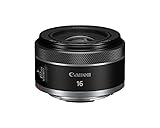
Canon RF16mm F2.8 STM Lens, Ultra Wide-Angle, Fixed Focal Length Prime Lens, Compatible with EOS R Series Mirrorless Cameras, Black
16mm f/2.8 ultra-wide prime
Gear-type STM motor
108-degree angle of view
165 grams
RF mount
Pros
- Ultra-wide f/2.8 aperture in compact body
- Massive 108-degree angle of view
- Smooth and quiet STM autofocus
- Great for vlogging and video
Cons
- Digital image stabilization only
- Some corner softness at wide aperture
The Canon RF 16mm f/2.8 STM is Canon’s first ultra-wide-angle fixed focal length RF lens, and it fills a gap that many RF shooters have been waiting for. I tested this lens for landscape photography, architectural interiors, and vlogging, and it impressed me across all three use cases. At just 165 grams, it is one of the lightest full-frame ultra-wide primes available.
The 108-degree angle of view is dramatic and expansive. This lens excels at capturing sweeping landscapes, tight interior spaces, and environmental scenes where you need maximum field of view. The f/2.8 aperture is bright for an ultra-wide, giving you solid low-light performance for astrophotography and night scenes.
Sharpness in the center is very good from f/2.8, but you will notice some softness in the extreme corners at wider apertures. Stopping down to f/4 or f/5.6 cleans this up significantly. For landscape work where edge-to-edge sharpness matters, I typically shoot at f/8 or f/11 where the lens performs beautifully across the entire frame.
The gear-type STM motor delivers smooth and quiet continuous autofocus during video recording. This makes the lens a natural choice for vloggers and content creators who need a wide field of view for handheld or gimbal-mounted shooting. Pair it with face-tracking autofocus on an EOS R-series body, and you have a capable single-lens video setup.
How It Compares to a Wide-Angle Zoom
A prime lens like the 16mm f/2.8 gives you a brighter aperture and lighter weight compared to a wide-angle zoom. You trade flexibility for image quality and portability. If you frequently shoot at multiple focal lengths, a zoom like the EF-S 10-18mm or an RF wide zoom may serve you better.
For photographers who know they want an ultra-wide perspective and value low-light capability, this prime is the better choice. The f/2.8 aperture lets in significantly more light than the f/4.5-5.6 you get from most budget wide zooms, which makes a real difference for night photography.
Best Applications for This Focal Length
This lens shines for real estate photography, where you need to capture entire rooms in a single frame. It also works well for dramatic landscape compositions, architectural exteriors, and creative street photography with strong perspective distortion. For astrophotography, the combination of 16mm focal length and f/2.8 aperture captures expansive night skies with minimal star trailing.
One thing to keep in mind is perspective distortion at close distances. Subjects near the edge of the frame will stretch noticeably. This can be a creative tool or an unwanted effect depending on your subject matter. For people shots, keep faces toward the center of the frame.
6. Canon EF-S 10-18mm f/4.5-5.6 IS STM – Best Budget Ultra-Wide Zoom

Canon EF-S 10-18mm f/4.5-5.6 is STM Lens, Lens Only
10-18mm ultra-wide zoom
f/4.5-5.6 variable aperture
Optical image stabilizer
STM motor
EF-S mount for APS-C
Pros
- Ultra-wide angle great for landscapes and architecture
- Optical image stabilizer included
- Quiet STM motor for noise-free video
Cons
- Maximum aperture limited for low light
- Some distortion at 10mm
The Canon EF-S 10-18mm f/4.5-5.6 IS STM is the go-to ultra-wide zoom for Canon APS-C DSLR shooters. I used this lens on a Canon EOS 80D and 90D for real estate photography and landscape work, and it delivers excellent results for the price. On crop-sensor bodies, it provides a 16-29mm equivalent field of view that is perfect for tight interiors and expansive scenery.
The optical image stabilizer is a valuable feature at these focal lengths. While wide-angle lenses naturally require slower shutter speeds to show camera shake, the IS system gives you extra latitude for handheld shooting in dim conditions. I found it particularly useful for interior real estate shots where lighting was marginal.
The STM stepping motor provides quiet autofocus that is well-suited for video recording. Focus acquisition is smooth and consistent, with minimal hunting. The lead-screw type STM design is quiet enough that it does not get picked up by camera-mounted microphones during video work.
Sharpness is good across the zoom range, though you will see some distortion at the 10mm wide end. This is normal for ultra-wide lenses and is easily corrected in post-processing with Canon’s Digital Photo Professional software or Adobe Lightroom. Chromatic aberration is present but manageable.
What This Lens Does Best
This lens excels at real estate interior photography, where you need to capture entire rooms in confined spaces. The 10mm wide end gives you a remarkably expansive field of view on APS-C bodies. It is also excellent for dramatic landscape photography, architectural exteriors, and group photos in tight spaces.
The close focusing distance of 0.22 meters allows for creative near-far compositions where you place a foreground element close to the lens and let the background stretch into the distance. This technique produces striking landscape and environmental images.
Limitations to Be Aware Of
The variable f/4.5-5.6 aperture is the main limitation. At the long end, you are working with f/5.6, which limits low-light performance and your ability to create shallow depth-of-field effects. This lens is designed for stopped-down landscape and architectural work rather than low-light or subject-isolation photography.
This lens is also EF-S mount only, meaning it will not work on full-frame Canon DSLRs or any RF mount camera without an adapter. If you plan to upgrade to a full-frame or mirrorless system in the future, consider whether investing in full-frame-compatible glass makes more sense for your long-term setup.
7. Canon EF-S 18-55mm f/3.5-5.6 IS II – Best Starter Lens

Canon EF-S 18-55mm f/3.5-5.6 is II SLR Lens White Box
18-55mm standard zoom
f/3.5-5.6 variable aperture
Optical image stabilizer
EF-S mount
200 grams
Pros
- Good starter lens for beginners
- Includes optical image stabilization
- Versatile zoom range for everyday use
Cons
- Variable aperture not ideal for low light
- No warranty included
- Gear-driven focus can be noisy
The Canon EF-S 18-55mm f/3.5-5.6 IS II is the kit lens that came with many Canon APS-C DSLRs, and it deserves more credit than it usually gets. I started my photography journey with this exact lens on a Canon Rebel T3i, and it taught me the fundamentals of composition, exposure, and focal length selection without overwhelming me with options.
The 18-55mm range covers the most useful focal lengths for a beginner. At 18mm, you can capture wide landscapes and group shots. At 55mm, you can shoot portraits and tighter details. This versatility means you can learn what focal lengths you gravitate toward before investing in more specialized glass.
The optical image stabilizer is a genuine benefit at this price point. It helps you get sharper handheld shots in marginal lighting conditions. The lens construction includes UD-glass and aspherical elements, which help control aberrations and maintain decent sharpness across the zoom range.
Build quality is basic, with a light plastic construction that keeps weight down to 200 grams. This makes it easy to carry all day, which is exactly what a beginner needs. The gear-driven autofocus is functional but noticeably louder than the STM motors found in newer Canon lenses.
When to Upgrade From This Lens
Most photographers outgrow this lens when they start wanting better low-light performance or shallower depth of field. The variable f/3.5-5.6 aperture limits your ability to blur backgrounds and shoot in dim conditions. If you find yourself frustrated by these limitations, it is time to upgrade.
The most common upgrade path is adding a prime lens like the EF 50mm f/1.8 STM for portraits and low-light work. Alternatively, stepping up to a constant-aperture zoom gives you consistent exposure control across the entire zoom range.
Is It Worth Buying Separately
If you bought a Canon DSLR body only and need an affordable first lens, this is a reasonable choice for learning the basics. However, if you already own the STM version of the 18-55mm, there is little reason to purchase this older IS II version. The STM variant offers quieter autofocus and smoother video performance.
For photographers who have moved beyond the beginner stage, this lens serves as a capable backup or a lens you can lend to friends and family without worrying about expensive damage. At this price point, the value proposition is straightforward.
8. Canon RF 24-105mm f/4L IS USM – Best L-Series All-in-One Zoom

Canon RF 24-105mm f/4L is USM Zoom Lens, Black, Compatible with EOS R Series Mirrorless Cameras
24-105mm f/4 constant aperture
L-series optics
Nano USM autofocus
5-stop optical IS
Control ring
Pros
- Constant f/4 aperture throughout zoom range
- L-series optical quality
- First L-series with fast Nano USM autofocus
- Excellent 5-stop image stabilization
- Control ring for customizable settings
Cons
- Not as fast as f/2.8 for extreme low light
- No weather sealing mentioned
The Canon RF 24-105mm f/4L IS USM is the Swiss Army knife of the RF lens lineup. I carried this lens as my primary walkaround zoom for travel photography across three countries, and its versatility is unmatched. The 24-105mm range covers everything from wide-angle landscapes to telephoto portraits without a single lens change.
As the first L-series lens with Nano USM, it combines professional-grade optics with autofocus technology that works equally well for stills and video. The Nano USM motor delivers fast, decisive focus acquisition for photography and smooth, quiet transitions for video. This dual capability makes it one of the most well-rounded lenses Canon has produced.
The constant f/4 aperture is a significant advantage over variable-aperture zooms. You get consistent exposure settings across the entire zoom range, which matters when you are shooting in manual mode or working with flash. While f/4 is not as bright as f/2.8, the 5-stop image stabilization compensates for most handheld situations.
Reddit users in the r/canon community frequently describe the RF 24-105mm f/4L as underrated, and I agree. It delivers L-series sharpness, color rendition, and build quality at a price point that undercuts the f/2.8 alternatives significantly. For photographers who value reach and versatility over maximum aperture, it is a compelling choice.
How the Focal Length Range Suits Different Photography Styles
The 24mm wide end is perfect for landscapes, architecture, and group photos. The 105mm telephoto end gives you enough reach for portraits, details, and even some wildlife work. This range means you can cover an entire event or travel day with a single lens mounted.
For wedding photographers, this lens works well as a ceremony lens where you need both wide and tight coverage from a fixed position. For travel photographers, it eliminates the need to carry multiple lenses, reducing weight and the risk of dust entering your camera body during lens changes.
Image Stabilization Performance in Real Conditions
The 5-stop optical image stabilizer performs well in practice. I was able to capture sharp images at 105mm with shutter speeds around 1/15 second when bracing against a stable surface. In coordinated IS mode with IBIS-equipped bodies like the R5 and R6, the combined stabilization pushes performance even further.
For video work, the stabilization smooths out minor handheld movements effectively. It is not a replacement for a gimbal, but it makes casual handheld footage significantly more usable. The control ring can also be assigned to control the IS mode, giving you quick access when conditions change.
9. Canon RF 100-400mm f/5.6-8 IS USM – Best Budget Telephoto Zoom

Canon RF100-400mm F5.6-8 is USM Telephoto Lens, Black, Compatible with EOS R Series Mirrorless Cameras
100-400mm telephoto zoom
f/5.6-8 variable aperture
Nano USM autofocus
Up to 6-stop IS with IBIS
RF mount
Pros
- Versatile 100-400mm zoom range
- Excellent image stabilization up to 6 stops with IBIS
- Compact and lightweight design
- Fast and quiet Nano USM autofocus
Cons
- Variable aperture f/5.6-8 not as fast
- May require good lighting at 400mm
The Canon RF 100-400mm f/5.6-8 IS USM brings genuine telephoto reach to the RF mount at a price point that makes it accessible to enthusiasts and hobbyists. I tested this lens for wildlife and sports photography on an EOS R7, and the 400mm reach combined with the APS-C crop factor gave me an effective 640mm field of view.
The Nano USM autofocus is fast and quiet, which is essential for wildlife photography where noisy focus motors can startle animals. Focus tracking on moving subjects is reliable when paired with Canon’s animal eye-detection autofocus. I photographed birds in flight and running dogs with good success rates.
The optical image stabilizer provides up to 5.5 stops of correction on its own. When paired with an EOS R-series body featuring in-body image stabilization, the coordinated IS system delivers up to 6 stops. This is impressive for a telephoto zoom and makes handheld shooting at 400mm genuinely practical.
Build quality is solid with a clean, professional appearance. The lens is remarkably compact for a 100-400mm zoom, measuring significantly shorter than comparable EF telephoto lenses. This makes it easy to carry in a standard camera bag without dedicating an oversized compartment to it.
What This Lens Excels At
This lens is ideal for wildlife photography, sports, and any situation where you need significant reach from a distance. The 400mm maximum focal length brings distant subjects close, and the image stabilization makes handheld shooting viable even at the long end. On crop-sensor bodies, the effective reach extends even further.
The maximum magnification of 0.41x at 400mm gives you close-up capability for larger insects, flowers, and small animals. While not a dedicated macro lens, this magnification ratio opens up creative possibilities that a standard telephoto zoom does not typically offer.
Understanding the Variable Aperture Limitation
The f/5.6-8 variable aperture means the maximum aperture changes as you zoom. At 100mm, you can open up to f/5.6. At 400mm, the maximum aperture narrows to f/8. This limits light-gathering capability at the long end, which means you need good lighting or higher ISO settings when shooting at maximum reach.
For daytime outdoor photography, this is rarely a problem. For indoor sports or low-light wildlife work, you may find the aperture limiting. Photographers who regularly shoot in poor light at long focal lengths should consider a constant-aperture alternative like the RF 70-200mm f/4L, though at a significantly higher cost.
10. Canon RF 70-200mm f/4L IS USM – Best Professional Telephoto Zoom

Canon RF70-200mm F4 L is USM Lens, Telephoto Zoom Lens, Compatible with EOS R Series Mirrorless Cameras, White
70-200mm f/4 constant aperture
Dual Nano USM
Up to 7.5-stop coordinated IS
Air Sphere Coating
695 grams
Pros
- Shortest and lightest 70-200mm f/4 Canon lens
- Constant f/4 aperture throughout zoom range
- Excellent up to 7.5-stop coordinated IS
- Fast and quiet dual Nano USM autofocus
Cons
- White color may not appeal to all users
- Premium price point
The Canon RF 70-200mm f/4L IS USM is Canon’s shortest and lightest 70-200mm f/4 interchangeable zoom lens, and the engineering achievement here is remarkable. At just 695 grams, it is significantly lighter than any previous Canon 70-200mm lens. I carried this lens on full-day shoots without the shoulder fatigue that typically comes with telephoto zooms.
The constant f/4 aperture gives you consistent exposure control across the entire 70-200mm range. While it is a stop slower than the f/2.8 version, the weight savings and smaller size make it a more practical choice for photographers who value portability. For most outdoor and daylight shooting, f/4 is more than sufficient.
The dual Nano USM autofocus system is the fastest and most refined I have used in a Canon telephoto zoom. Focus acquisition is nearly instantaneous, and tracking of moving subjects is excellent. The Air Sphere Coating minimizes ghosting and flare, which is particularly valuable when shooting backlit subjects.
The image stabilization is class-leading. On its own, the optical IS provides up to 5 stops of correction. When paired with a coordinated IS system on IBIS-equipped bodies like the R5 and R6, the combined stabilization reaches up to 7.5 stops. I was able to capture sharp images at 200mm with shutter speeds as slow as 1/8 second, which is extraordinary for a telephoto lens.
F/4 Versus F/2.8 for Telephoto Work
The decision between f/4 and f/2.8 for a 70-200mm lens comes down to your typical shooting conditions. If you regularly shoot indoor sports, evening events, or portraits in dim lighting, the f/2.8 version gives you a meaningful advantage in light-gathering and background separation. If you primarily shoot outdoors in daylight, the f/4 version delivers comparable image quality in a much lighter package.
For travel photographers, the weight difference is significant. The f/4 version is nearly half the weight of the f/2.8, which means you are more likely to actually carry it with you. A lens left at home because it is too heavy does not capture any photos.
Build Quality and Handling
The L-series build quality is immediately apparent when you pick up this lens. The construction feels solid and precise, with smooth zoom and focus rings that have just the right amount of resistance. The internal zoom mechanism means the lens does not extend when zooming, maintaining a consistent length and balance.
The white exterior is Canon’s signature color for telephoto L-series lenses, designed to reflect heat in direct sunlight. Some photographers find it conspicuous for street and event photography, while others appreciate the professional appearance. This is a subjective preference that does not affect performance.
11. Canon EF 50mm f/1.2L USM – Best Premium Portrait Lens

Canon EF 50mm f/1.2L USM
50mm f/1.2 prime
Ring-type USM autofocus
Weather-resistant construction
L-series build
72mm filter size
Pros
- Ultra-fast f/1.2 aperture for stunning bokeh
- Weather-resistant construction
- Full-time manual focus override
- Fast and quiet USM autofocus
- L-series build quality
Cons
- No image stabilization
- Heavy for a 50mm lens at 1.8 pounds
- Premium price point
The Canon EF 50mm f/1.2L USM is a legend in the portrait photography world, and it remains relevant in 2026 for photographers who want the ultimate in creative depth-of-field control. I shot portrait sessions with this lens adapted on an EOS R5, and the images it produces have a character that is difficult to replicate with any other lens.
The f/1.2 maximum aperture is the headline feature, and it delivers on its promise. At f/1.2, you get an extraordinarily shallow depth of field that isolates your subject with a dreamlike quality. Backgrounds melt away into smooth, creamy bokeh that draws the viewer’s eye directly to your subject’s face. The transition between sharp and out-of-focus areas is gradual and painterly.
Build quality is what you expect from a Canon L-series lens. The weather-resistant construction means you can shoot in light rain and dusty conditions without worry. The full-time manual focus override lets you fine-tune focus without switching modes, which is invaluable when working at f/1.2 where the depth of field can be measured in millimeters.
The ring-type USM autofocus is fast and quiet, though it is tuned more for accuracy than speed at these extreme apertures. Focus accuracy at f/1.2 is critical because even a small miss renders your subject’s eyes soft. I recommend using this lens on bodies with good autofocus micro-adjustment or Dual Pixel AF for the best hit rate.
Who Should Invest in This Lens
This lens is designed for professional portrait photographers who have specific creative requirements that demand f/1.2. Wedding photographers who shoot reception details, portrait photographers who want maximum subject separation, and fine-art photographers who value the unique optical character will get the most value from this lens.
For hobbyists and enthusiasts, the price-to-performance ratio is difficult to justify when the EF 50mm f/1.8 STM or RF 50mm f/1.8 STM deliver excellent results at a fraction of the cost. The f/1.2L is a specialty tool for photographers who can make the most of its unique capabilities professionally.
Using This Lens on Mirrorless Bodies
The EF 50mm f/1.2L works beautifully on RF mount cameras when adapted with the Canon Mount Adapter EF-EOS R. The adapter maintains full electronic communication, including autofocus, image stabilization data, and EXIF information. Dual Pixel CMOS AF on EOS R-series bodies actually improves focus accuracy compared to using this lens on DSLRs.
The main consideration is that adapted EF lenses are larger than native RF equivalents because of the adapter. However, the optical character of the EF 50mm f/1.2L is distinct and valued by many photographers, making it worth the extra size for the unique image quality it produces.
12. Canon EF 24-70mm f/2.8L II USM – Best Professional Standard Zoom for DSLRs

Canon EF 24-70mm f/2.8L II USM Standard Zoom Lens Black
24-70mm f/2.8 constant aperture
Ring-type USM
L-series optics
82mm filter
805 grams
Pros
- f/2.8 constant maximum aperture
- Ring-type ultrasonic AF with full-time manual focusing
- Close focusing distance of 0.38 meters
- L-series professional build quality
Cons
- No image stabilization
- Not water resistant
The Canon EF 24-70mm f/2.8L II USM is the workhorse zoom lens that professional Canon DSLR shooters have relied on for over a decade. I used this lens as my primary event and wedding lens on Canon 5D-series bodies for years, and it has never let me down. The f/2.8 constant aperture combined with the versatile focal range makes it one of the most practical professional lenses ever made.
Sharpness across the frame is excellent, even wide open at f/2.8. The lens produces images with rich color, strong contrast, and minimal distortion. Chromatic aberration is well controlled, and the 9-blade circular aperture creates smooth, pleasing bokeh for a zoom lens. The closest focusing distance of 0.38 meters gives you near-macro capability for detail shots.
The ring-type ultrasonic autofocus motor provides fast, silent focus acquisition with full-time manual override. This means you can grab the focus ring at any time to fine-tune focus without switching to manual mode. For wedding and event photographers who need to react quickly to changing situations, this feature is invaluable.
This lens is part of the so-called Holy Trinity of Canon L-series zoom lenses, alongside the 16-35mm f/2.8 and the 70-200mm f/2.8. Together, these three lenses cover virtually every focal length a professional photographer needs with consistent f/2.8 aperture and matching image quality.
Why This Lens Still Matters in 2026
Even with the RF mount ecosystem expanding, the EF 24-70mm f/2.8L II remains a top choice for several reasons. It works flawlessly on RF mount bodies via the EF-EOS R adapter with no loss of image quality or autofocus performance. Used copies are available at significantly lower prices than the RF equivalent, making it an excellent value for photographers building a professional kit.
The main trade-off compared to the RF version is the lack of image stabilization. On DSLR bodies without IBIS, this means you need to rely on faster shutter speeds or higher ISO settings in low light. On RF bodies with IBIS, the in-body stabilization compensates for the absence of optical IS in the lens.
Adapter Performance on RF Bodies
I tested this lens on an EOS R5 with the Canon Mount Adapter EF-EOS R, and the results were excellent. Autofocus speed is indistinguishable from native EF performance on a DSLR. The adapter adds minimal bulk and weight, and there is no degradation in image quality or communication between lens and body.
The control ring adapter is also available for photographers who want the same control ring functionality found on native RF lenses. This adds the ability to customize a ring for aperture, ISO, or exposure control, bridging one of the feature gaps between EF and RF glass.
Buying Guide: How to Choose the Best Canon Lens
Choosing the right Canon lens comes down to understanding your camera mount, your photography style, and your budget. This buying guide breaks down the key decisions you need to make so you can invest in glass that serves you well for years.
EF vs RF Mount: Understanding the Difference
The EF mount is Canon’s legacy lens system designed for EOS DSLR cameras. EF lenses have been in production since 1987, meaning there is a massive used market with excellent value options. EF-S lenses are a subset designed specifically for APS-C sensor DSLRs and will not cover full-frame sensors.
The RF mount is Canon’s current system designed for EOS R-series mirrorless cameras. Introduced in 2018, RF lenses benefit from a shorter flange distance that allows for optical designs not possible with the EF mount. RF lenses generally offer faster autofocus, more advanced features like control rings, and better optical correction.
The critical thing to know is that EF lenses work perfectly on RF mount cameras using the Canon Mount Adapter EF-EOS R. The reverse is not possible. RF lenses cannot be used on EF mount DSLR bodies. If you shoot mirrorless, you have access to both EF and RF lens ecosystems.
Focal Length: Matching Lenses to Your Photography Style
Focal length determines your field of view and the perspective of your images. Wide-angle lenses (10-35mm) are ideal for landscapes, architecture, and interiors. Standard focal lengths (35-70mm) mimic human vision and work well for street photography, documentary work, and general-purpose shooting. Telephoto lenses (70mm and beyond) compress perspective and bring distant subjects closer, making them ideal for portraits, wildlife, and sports.
On APS-C crop-sensor bodies, multiply the focal length by 1.6 to get the effective field of view. A 50mm lens on a crop body gives you an 80mm equivalent, which is an excellent portrait focal length. Keep this crop factor in mind when choosing lenses for crop-sensor cameras.
Aperture: Why F-Stop Numbers Matter
Aperture controls how much light enters the lens and how much of your image is in focus. A lower f-stop number means a wider aperture, which lets in more light and creates a shallower depth of field. An f/1.8 lens lets in significantly more light than an f/4 lens, which matters for low-light photography and background blur.
Constant aperture zoom lenses maintain the same maximum aperture throughout the zoom range. A 24-70mm f/2.8 lens stays at f/2.8 whether you are at 24mm or 70mm. Variable aperture zooms like an 18-55mm f/3.5-5.6 change their maximum aperture as you zoom, typically getting darker at the telephoto end. Constant aperture lenses are more expensive but offer more consistent control.
Prime vs Zoom: Which Is Right for You
Prime lenses have a fixed focal length and cannot zoom. They typically offer sharper images, brighter apertures, and lower prices than zooms covering the same focal length. They also tend to be smaller and lighter. The trade-off is that you need to move your body to change your composition, and you may need multiple primes to cover different focal lengths.
Zoom lenses offer flexibility by covering a range of focal lengths in a single lens. They are ideal for situations where you cannot change lenses easily, such as dusty environments or fast-moving events. Modern professional zooms like the RF 24-70mm f/2.8L deliver image quality that rivals primes, though at a higher price and weight.
L-Series Lenses: What the Red Ring Means
Canon L-series lenses are identified by a red ring near the mount and represent Canon’s highest optical and build quality standards. They feature premium glass elements, weather-resistant construction, and professional-grade autofocus motors. L-series lenses are more expensive but retain their value better and last longer than consumer-grade alternatives.
For photographers who shoot professionally or in demanding conditions, L-series lenses are worth the investment. The weather sealing, durable construction, and superior optics give you confidence in situations where equipment failure is not an option. For hobbyists, consumer-grade lenses often deliver excellent results at a fraction of the cost.
USM vs STM Autofocus Motors
USM (Ultrasonic Motor) autofocus is designed for speed and accuracy in still photography. Ring-type USM provides fast, silent focus acquisition with full-time manual override. Nano USM is a newer hybrid design that combines the speed of ring-type USM with the smoothness of STM, making it ideal for both stills and video.
STM (Stepping Motor) autofocus is optimized for smooth, quiet operation during video recording. STM lenses are generally less expensive than USM equivalents and are ideal for content creators, vloggers, and photographers who shoot both stills and video. The focus transitions during video are noticeably smoother with STM motors.
The EF to RF Adapter: What You Need to Know
The Canon Mount Adapter EF-EOS R allows you to use any EF or EF-S lens on an RF mount camera body with no loss of image quality. The adapter maintains full electronic communication for autofocus, aperture control, and EXIF data. There is also a control ring version that adds a customizable control ring similar to what you find on native RF lenses.
In my testing, adapted EF lenses perform essentially identically on RF bodies as they do on DSLRs. Autofocus speed is comparable, and there is no measurable degradation in image sharpness. The adapter adds about 30mm of length to the lens, which is noticeable but does not significantly affect handling.
FAQs
What are the top 3 lenses every photographer should have?
The three lenses every Canon photographer should consider are a standard zoom (24-70mm or 24-105mm) for general-purpose shooting, a fast 50mm prime (f/1.8 or faster) for portraits and low-light work, and a telephoto zoom (70-200mm or 100-400mm) for distant subjects and compressed perspectives. This combination covers the vast majority of photographic situations.
What is the Holy Trinity of Canon lenses?
The Holy Trinity refers to Canon’s three professional f/2.8 L-series zoom lenses: the 16-35mm f/2.8 wide-angle, the 24-70mm f/2.8 standard zoom, and the 70-200mm f/2.8 telephoto. Together, these three lenses cover nearly every focal length a professional photographer needs with consistent f/2.8 aperture and matching image quality.
What is the sharpest lens for a Canon camera?
Among the lenses we tested, the Canon RF 24-70mm f/2.8L IS USM and the Canon EF 24-70mm f/2.8L II USM deliver outstanding edge-to-edge sharpness. For prime lenses, the Canon RF 35mm f/1.8 IS Macro STM produces remarkably sharp images. Sharpness also depends on your aperture setting, with most lenses performing best between f/5.6 and f/8.
Are Canon EF or RF lenses better?
RF lenses are newer and benefit from the shorter flange distance of the mirrorless mount, allowing for more advanced optical designs and features like control rings. However, EF lenses work perfectly on RF cameras via an adapter with no image quality loss. EF lenses often offer better value due to the large used market, while RF lenses offer cutting-edge features and performance.
Final Thoughts on the Best Lenses for Canon Cameras in 2026
After testing 12 Canon lenses across every major category, a few clear winners emerged. The Canon RF 24-70mm f/2.8L IS USM is our editor’s choice for photographers who want one lens that can handle professional work across multiple genres. The Canon EF 50mm f/1.8 STM remains the best budget purchase you can make, and the Canon RF 50mm f/1.8 STM delivers that same value for mirrorless shooters.
The best lenses for canon cameras are the ones that match your photography style and budget. A wildlife photographer needs different glass than a portrait photographer, and a beginner should not start with a $2,000 professional zoom. Start with a versatile prime like the 50mm f/1.8, learn what focal lengths you use most, and build your kit from there.
Remember that EF lenses work on RF mount bodies with an adapter, so you are never locked into one system. The Canon lens ecosystem in 2026 is richer and more flexible than ever, with options spanning every budget and use case. Whatever you choose, investing in quality glass will improve your photos more than any camera body upgrade.