
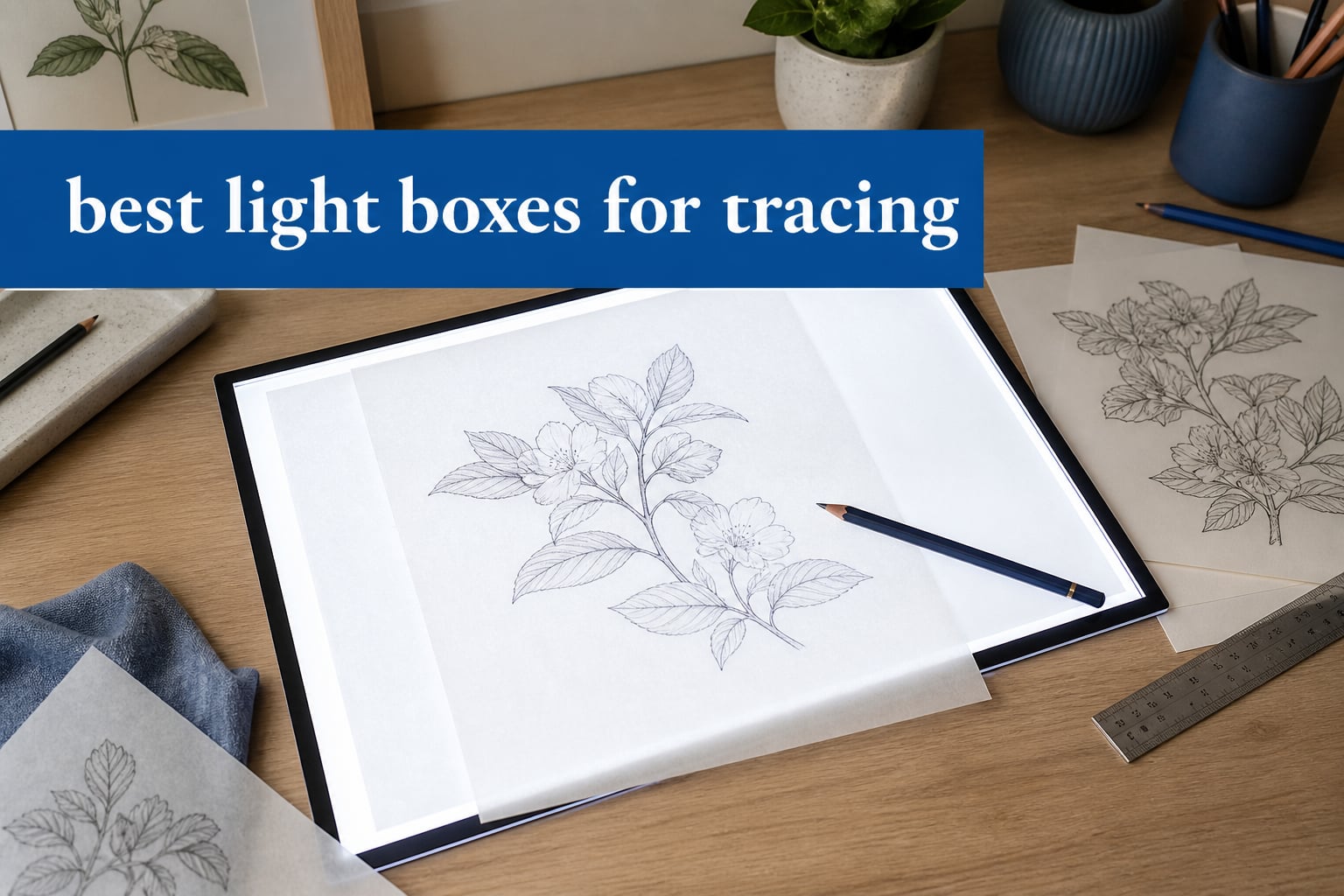
The best light boxes for tracing make transferred line work clearer without asking you to tape a sketch to a window. A good light pad puts even LED illumination beneath paper, fabric, or a stencil so the original marks remain visible while you draw, ink, or mark the new surface.
I compared the supplied product specifications, review totals, ratings, stated brightness, dimensions, controls, and power arrangements for eight current options. The result is a practical list for illustrators, tattoo-stencil makers, quilters, embroiderers, diamond painters, animation students, and anyone moving a drawing from one sheet to another.
There is no universal winner because workspace, paper weight, and where you work matter more than a single headline number. An A4 tracing light pad is easy to keep beside a sketchbook, while an A2 or A1 board makes sense only when your originals, quilt blocks, or layouts truly need that span.
Professional artists do use light boxes when accuracy and repeatability matter. They are a normal transfer tool for clean animation line art, tattoo designs, watercolor underdrawings, calligraphy guides, and revisions; they do not replace drawing skill, but they remove the awkwardness of holding work against a window.
My first filter is practical: choose a bright, even panel with controls you will not bump mid-line. Community discussions repeatedly point to uneven illumination, weak power from some USB setups, short battery sessions, and dim panels under heavy watercolor paper, so I call out the listed features that address those problems instead of treating every thin panel as interchangeable.
Table of Contents
Top 3 Picks – Best Light Boxes for Tracing
For most people who want cordless A4 flexibility, the Bawaslom offers 9000 Lux, a 4000mAh battery with a listed five-hour runtime, a stand, and magnets. The HSK is the straightforward pick when a compact, established A4 pad with a lock feature matters most, while the DEAR CARBON is the clear choice when a normal desk-size pad is simply too small.
Bawaslom Rechargeable A4: Best all-around cordless setup for tracing, craft work, and angled drawing.
HSK 9 by 13 inch A4: Best simple choice for reliable, even illumination in a thin aluminum-frame pad.
DEAR CARBON A2: Best large-format board for broad drawings, quilting layouts, and bigger sheets.
Best Light Boxes for Tracing in 2026 Comparison
Use the overview to narrow the field by format and power before reading the full reviews. Lux numbers come from each manufacturer listing and are useful for comparing the supplied models, but paper opacity, evenness, and ambient room light still affect what you can see through a sheet.
| Product | Specifications | Action |
|---|---|---|
 Bawaslom Rechargeable A4 Bawaslom Rechargeable A4 |
|
View Details |
 HSK 9 by 13 inch A4 HSK 9 by 13 inch A4 |
|
View Details |
 DEAR CARBON A2 Light Pad DEAR CARBON A2 Light Pad |
|
View Details |
 TOHETO A4 Light Board TOHETO A4 Light Board |
|
View Details |
 Zocelight Rechargeable A3 Zocelight Rechargeable A3 |
|
View Details |
 WELZK A1 Light Pad WELZK A1 Light Pad |
|
View Details |
 Heanolier Rechargeable A4 Heanolier Rechargeable A4 |
|
View Details |
 YINGWOND Rechargeable A4 YINGWOND Rechargeable A4 |
|
View Details |
1. The Bawaslom Rechargeable A4 is the strongest all-around cordless tracing choice.
Bawaslom Rechargeable A4 LED Diamond Painting Light Board for Tracing,Black
A4
9000 Lux
4000mAh battery
10-level stand
Pros
- 9000 Lux output
- Five-hour listed cordless use
- 10-level stand
- Four magnets
- Physical side buttons
Cons
- A4 workspace
- 1.08kg weight
The Bawaslom is the model I would start with for someone who wants one tracing board to cover drawing, diamond art, stencil work, calligraphy, and embroidery without being tied to an outlet. Its listing combines the details that tend to make a light pad less fiddly in daily use: physical side buttons, four magnets, an adjustable stand, and a 4000mAh rechargeable battery.
The stated maximum is 9000 Lux, with three color modes and six brightness levels in each mode. That range is more useful than a one-setting panel because a faint pencil original and a bold printed reference do not need the same output, and soft even light is specifically claimed for eye comfort.
The supplied customer data shows a 4.8 rating from 206 reviews. That is a much smaller evidence pool than the HSK, but the review summary specifically highlights the even lighting, stand, and long cordless capability rather than one isolated feature.
The 13.86 by 10 inch body remains an A4-format choice, so it is not a substitute for a wide comic page or large embroidery layout. At 1.08 kilograms, it also has more heft than the very thin basic pads, though that may feel reassuring when it is propped on the stand.
The stand and magnets make this a better fit for stationary tracing sessions.
The foldable stand has 10 adjustment levels, which lets you place the working surface at a slope instead of staying hunched over a flat desk. I like that pairing for pencil transfer, line cleanup, or diamond painting where your neck position matters after an hour, not just in the first few minutes.
The four included magnets can keep paper or a canvas from drifting. This is a small detail with a real workflow payoff: a traced edge stays registered when you lift your hand, erase a guide mark, or take a break.
The battery makes this a better fit for a flexible workspace than a fixed studio desk.
Bawaslom lists about five hours of cordless operation and Type-C charging. That is enough for a session away from a wall socket, but it is still wise to treat the stated runtime as a session length rather than an all-day promise, especially when working at high brightness.
The physical-button setup also answers a common forum complaint about touch controls changing when a sleeve or wrist brushes the panel. Choose this one when you need a portable art light box with enough brightness and practical holding features for regular transfer work.
2. The HSK 9 by 13 inch A4 is the best simple light pad for everyday line transfer.
HSK 9”x13”LED Artist tracing Light Box Copy Table, Adjustable High Brightness Light Pad for Tatto Drawing, Sketching, Animation, Diamond Painting Accessories
A4
6000 Lux
0.23 inch frame
lock feature
Pros
- 15k+ reviews
- Even flicker-free light
- Lock feature
- Thin aluminum frame
- Two-year warranty
Cons
- Corded DC power
- A4 workspace
The HSK is the no-drama option in this group: it is thin, corded, compact, and built around a stated 6000-Lux light guide board. If you trace at the same desk most of the time, I think that simple arrangement can be more useful than paying attention to charging status or carrying a heavier battery-equipped board.
Its 13 by 9 inch size, 0.23-inch profile, and aluminum frame target the classic A4 drawing-light-pad role. The brand lists a light guide board for even illumination and flicker-free operation, two points that matter because hotspots and visible flicker are among the most frequent disappointments people report with lower-grade panels.
It has the deepest review history here, with a 4.7 rating across more than 15,000 reviews, plus a number-two Artists Light Boxes rank in the supplied demand data. That does not mean it is the right size for every project, but it is stronger social proof for a basic A4 design than a newly listed alternative with only a small review sample.
Touch controls handle power and brightness, and the lock feature is the headline advantage. The product instructions say you hold the dimmer up or down control for three seconds to lock or unlock it, which means you can set the light and concentrate on the transfer rather than checking for accidental inputs.
The locked control panel makes this a sound pick for repetitive, close-up work.
When you are tracing a tattoo stencil, animation frame, calligraphy layout, or quilting pattern, an unintended brightness change breaks concentration. The HSK lock is a direct response to that issue, so I would favor it for users who rest a hand near the panel or work with materials that may brush the edge.
The physical form is also easy to store: a 0.23-inch pad takes little room in a drawer or a portfolio sleeve. Keep in mind that the unit uses DC power through its cable, so the available cable and socket position should be part of your desk plan.
The A4 working scale makes this best for sheets and motifs rather than wide layouts.
An A4 light box for drawing is excellent for sketchbook-sized transfers, individual tattoo designs, small sewing motifs, and compact diamond-painting areas. It becomes limiting when your reference crosses a seam or your paper needs to lie flat across a full spread.
If your regular work is larger than the 9 by 13 inch body, stepping up to A3, A2, or A1 avoids repositioning the original. For ordinary A4 tracing, though, the HSK’s long review record, even-light claim, and lock make it the sensible straightforward choice.
3. The DEAR CARBON A2 is the right answer for large drawings and broad craft layouts.
DEAR CARBON A2 Light Pad,LED Light Board for Diamond Painting,Tracing
A2
25.4 by 18.3 inches
three colors
stepless dimming
Pros
- Extra-large workspace
- Three color temperatures
- Stepless dimming
- Independent controller
- Dual scale markings
Cons
- Corded power
- 3-pound weight
The DEAR CARBON changes the decision from “which pad fits on my desk?” to “can I trace this entire layout without moving it?” Its 25.4 by 18.3 inch creative area is the biggest practical jump in this list before the even broader WELZK A1, making it a strong fit for illustration sheets, quilt layouts, stained-glass patterns, and large diamond-painting canvases.
It uses a corded electric arrangement with a supplied UL adapter, an aluminum frame, and a 0.35-inch thickness. At three pounds, this is a board to set up on a prepared work surface rather than something I would slide into a small bag between classes.
The technical list is unusually flexible: three color temperatures spanning 3000K to 10000K, ten brightness levels, and 0-to-100-percent stepless dimming. That means you can make a finer adjustment after choosing a warm, neutral, or cool appearance rather than relying only on a few preset steps.
The manufacturer also states flicker-free, eye-friendly LEDs and an independent controller. Separating the controller from the light surface is a practical choice for a large panel because you can adjust the output without reaching over the drawing, and it reduces the chance of a forearm triggering a touch point on the board.
The A2 surface is the reason to choose this model for one-piece tracing.
Large-format work gains accuracy when the original and the receiving sheet stay in the same position from beginning to end. I would pick this A2 board for full illustrations, broad lettering layouts, quilting blocks, or a watercolor composition where shifting the reference would make registration harder.
The dual inch and centimeter markings give you a reference edge for alignment and measured placement. They do not replace a full ruler, but they are helpful when you need to center a panel, transfer a border, or keep sequential motifs in a consistent position.
The controller and dimming range make this suited to varied papers and room conditions.
A big light pad can feel overpowering on thin copy paper but need much more output under denser stock. Stepless dimming gives you room to find the lowest setting that makes the original legible, which is usually more comfortable than running maximum brightness by default.
Its size, corded setup, and weight make it less convenient for a casual couch session. Choose it when surface area is the priority and you have a stable studio or craft table; choose an A4 battery board when portability comes first.
4. The TOHETO A4 is the brightest corded A4 option for detailed transfer work.
TOHETO A4 Light Board for Diamond Painting, Super Bright Magnetic Light Pad with Side Buttons, Lightbox for Tracing and Drawing, Corded Light Table for Sketching, Animation, Weeding Vinyl (Black)
A4
11000 Lux
three colors
memory function
Pros
- 11000 Lux maximum
- Side physical buttons
- Three light colors
- Memory function
- Dual scales
Cons
- Corded only
- A4 visible area
The TOHETO makes the clearest case for users who need the highest listed brightness in an A4-format tracing board. Its stated maximum reaches 11000 Lux, higher than the other A4 products in this selection, and the brand specifically positions that output for demanding detail work such as vinyl weeding.
Brightness is not the sole measure of a good LED light box, but it matters when a reference is less transparent or the room has strong ambient light. For tracing, a stronger panel can help reveal lines through heavier paper, provided the illumination stays even and you can dim it down when a thinner sheet needs less.
TOHETO provides white, warm, and mixed light modes, each with six brightness levels. It also lists a memory function, so the board returns to the latest light setting rather than making you cycle from the beginning at every session.
The standard A4 visual area is listed at 12.5 by 8.6 inches, within a 13.9 by 10 inch body. Four magnets and centimeter/inch scales add useful paper-management and alignment aids, while the side physical controls are deliberately placed away from the work surface.
The high brightness makes this a practical choice for opaque-paper transfers and vinyl work.
If you regularly trace on watercolor paper, test a corner first because paper weight, fibers, paint, and room light change the result. The 11000-Lux maximum gives the TOHETO more headroom than the other listed A4 panels when the original is faint or the top sheet is not especially translucent.
I would also look at this board for vinyl weeding, stencil preparation, and small technical drawings where fine cut lines need contrast. Start at a lower setting for thin paper; high output is helpful when needed, not a setting that has to stay on all the time.
The memory and side buttons make it better for a repeatable desk workflow.
People who trace the same kind of project on several days often develop a preferred color and brightness. The memory feature keeps that setup consistent, and the side physical button design reduces a common complaint about touch-sensitive panels changing settings during a task.
There is no built-in battery listed, so it must remain plugged in. That limitation is easy to accept on a fixed workstation, but it makes the Bawaslom, Zocelight, Heanolier, or YINGWOND more appropriate if you need to carry the light board around the house or studio.
5. The Zocelight Rechargeable A3 is the cordless choice for a larger working area.
Rechargeable A3 Light Pad for Diamond Painting,Tracing Light Box with Stand and Clip,3 Colors Stepless Dimmable and 6 Levels of Brightness Light Board for Artists,Drawing,Sketching,Animation
A3
2500mAh battery
six-angle stand
magnetic clip
Pros
- A3 visible workspace
- Five-hour listed battery use
- Six-angle stand
- Stepless dimming
- Top magnetic clip
Cons
- 1.5kg weight
- 2500mAh battery
The Zocelight bridges the gap between compact A4 boards and the fixed, broad A2 panels. Its A3 form offers a stated 15.35 by 11.89 inch visible work area, which is a meaningful improvement for larger drawings, full-page pattern pieces, animation layouts, or any transfer where an A4 panel would force you to move the artwork.
It has a 2500mAh rechargeable lithium battery, USB-C charging, a supplied six-foot cable, and a listed five-hour runtime. The battery offers freedom from a socket, while the cable lets you keep working when the battery needs a charge; that dual arrangement is useful in a shared craft room where outlets may be occupied.
The light modes include white, warm yellow, and warm white, with stepless 0-to-100-percent dimming and six brightness levels per mode. A listed 6500K color temperature is also provided, though the real advantage is being able to adjust the board around the reference and your room rather than forcing every project under one light appearance.
The foldable stand has six angles, and a top magnetic clip secures paper or a diamond-painting canvas. The included pencil and papers are extras, but the larger workspace, stand, and rechargeable operation are the features that define the decision.
The A3 footprint gives you more room for comics, patterns, and layered references.
A3 is the sweet spot when your sketch extends beyond a standard sheet but an A2 board would dominate your desk. I would consider it for comic layouts, embroidery pattern segments, sewing pieces, and multi-character drawings where keeping the whole reference visible helps preserve proportions.
That extra span does mean more mass: the supplied data lists 1.5 kilograms. It remains portable, but it is best moved as a planned work tool rather than treated like a featherweight A4 pad.
The stand and clip suit users who need the paper held in place at an angle.
A top clip can be easier than corner magnets when a long reference wants to slide downward on a slope. The six-angle stand gives you a modest choice of posture, which can reduce the tendency to lean over an entirely flat drawing light pad.
Battery time depends on brightness and usage conditions, and the listing’s five-hour figure should be read as a stated reference point. For a day of sustained work, keeping the USB-C cable available is sensible; for several short tracing sessions, cordless use is the main attraction.
6. The WELZK A1 is the best choice when the project is bigger than a standard desk pad.
WELZK A1 Light Pad for Diamond Painting, 7000 Lux Light Board for Tracing
A1
34.5 by 22.7 inches
7000 Lux
10 foot cable
Pros
- Very large A1 surface
- Three light colors
- Stepless dimming
- Physical buttons
- Three-year warranty
Cons
- 3.63kg weight
- Corded operation
The WELZK A1 is a specialist answer for very large tracing rather than an ordinary portable light box. Its 34.5 by 22.7 inch body provides a 2.9 by 1.9 foot-scale working surface, a dramatic change from A4 boards and enough room for large diamond paintings, broad watercolor sketches, poster-scale line art, or expansive design layouts.
It lists 7000 Lux, dual light bars, three adjustable colors, ten brightness levels, and stepless dimming. The stated output is lower than the TOHETO A4’s maximum, but direct lux comparison across different panel sizes is incomplete; the WELZK’s purpose is spreading usable illuminated space across an A1-format surface.
Physical buttons control the dimming rather than a touch area in the middle of the panel. That is a welcome design decision on a large board, where a hand, ruler, or big sheet can easily cover the active area and where accidental control changes would interrupt a long layout.
The package includes a UL-certified adapter and a 10-foot cable, and the supplied data lists a three-year warranty. These details point to a workstation-oriented setup, not a board meant to run wirelessly at a café table or move between rooms every day.
The A1 workspace is for full-size layouts that should stay registered in one position.
Repositioning a large original introduces opportunities for a crooked seam, an overlap, or a lost reference point. This is where the WELZK has a clear job: place a large sheet or canvas once, align it, and transfer the work without breaking it into small segments.
I would shortlist it for quilting, stained glass, wall-scale graphic sketches, technical design, and wide craft canvases. It can also support watercolor tracing, though any artist working on heavy watercolor paper should test whether the reference remains clear enough before committing to a final sheet.
The size and weight make this better as a dedicated surface than a portable pad.
The listed weight is 3.63 kilograms, and the panel is 0.3 inches thick. It is still slim, but its wide footprint calls for a firm tabletop, clear storage space, and a cable route that does not cross your working area.
Choose a smaller board if your work rarely exceeds an A3 sheet. Choose this one when broad coverage is non-negotiable, since an undersized light table creates more frustration than any extra feature can solve.
7. The Heanolier Rechargeable A4 is the most adjustable compact stand option.
Heanolier Rechargeable A4 Light Board with Stand, 7100Lux Super Bright Magnetic Light Pad with Side Buttons, Wireless Light Box for Tracing, LED Light Table for Diamond Painting,Sketching,Drawing
A4
7100 Lux
nine-angle stand
2500mAh battery
Pros
- Nine stand angles
- Full magnetic face
- Side buttons
- Two to six hour listed use
- Memory function
Cons
- A4 workspace
- Runtime varies by setting
The Heanolier focuses less on raw maximum output and more on making an A4 board comfortable to position. It combines a 7100-Lux listed maximum with a built-in foldable stand that adjusts through nine angles, a full magnetic design, physical side buttons, and a 2500mAh battery.
For many artists, position matters as much as brightness. A flat panel can work for quick transfers, but a board that tilts toward you can make it easier to see faint lines without curling over the desk, particularly when you are doing close detail or working through several reference sheets.
The stated illuminated workspace is 12.5 by 8.6 inches, inside a 13.9 by 10 inch body. That is ordinary A4 territory, yet the full magnetic face and four supplied magnets offer more flexible paper placement than a board that only provides a clip at one edge.
It offers three light colors, six levels plus stepless dimming, Type-C charging, and a memory function. The listed wireless runtime is two to six hours, an honest reminder that output settings have a material effect on battery sessions.
The nine-angle stand is the feature that separates this from a basic A4 board.
The broad range of stated stand positions gives you more opportunities to match the board to your chair height and task. I would favor this design for sketch transfer, lettering, streaming setups, or diamond painting where a sloped plane is easier on your posture than a completely horizontal light surface.
Before buying any stand-equipped panel, consider the depth of your desk. A tilted A4 board occupies more forward space than a flat pad, but the adjustment can be worthwhile if you routinely experience neck fatigue when looking down at tracing work.
The magnetic face and side buttons make this a capable portable craft companion.
A full magnetic surface can hold an oddly shaped reference, a small paper note, or a canvas without forcing every item into a top clip. That can be useful for embroidery transfers and layered pencil sketches where the material does not sit neatly at one edge.
The runtime range is wider than the five-hour statements on some other boards, so plan on charging if you use the highest brightness for long stretches. Pick the Heanolier when adjustable posture and magnetic paper control matter more than having the largest panel.
8. The YINGWOND Rechargeable A4 is the most portable carrying-case option.
YINGWOND 9000LUX A4 Rechargeable Tracing Light Box with Padded Case,Wireless Diamond Art Light Board,Side Physical Buttons and Magnetic Portable Light Pad for Diamond Painting,Drawing,Sketching
A4
9000 Lux
4000mAh battery
padded carry case
Pros
- Padded shoulder case
- 9000 Lux brightness
- Five-hour listed use
- Metal side buttons
- Three light colors
Cons
- A4 workspace
- 75 reviews
The YINGWOND is built for taking a tracing light pad to class, a craft group, or another work area without leaving it exposed in a tote. It includes a padded canvas carry bag with a shoulder strap, plus an A4 panel with a 4000mAh battery, listed five-hour use, side physical metal buttons, magnets, and a 9000-Lux maximum.
The carry case is not merely an extra when a panel has an acrylic and plastic body. Scratch-prone surfaces are a recurring concern among light-box buyers, and a dedicated padded bag gives you a sensible place to keep the board, cable, magnets, and reference papers between sessions.
Three colors and stepless brightness adjustment cover the core lighting needs, while the green magnets hold paper and diamond paintings in place. The product data claims that its 9000-Lux output penetrates 250g drawing paper, which is a useful manufacturer claim for heavy-paper shoppers but should still be tried with your own particular reference and paper combination.
With a 4.6 rating from 75 reviews, this is one of the smaller review samples in the roundup. I would give more weight to its clearly listed travel features and less weight to broad long-term conclusions until its review history grows.
The padded shoulder case makes this the better match for artists who move between locations.
If you work at a studio one day and a kitchen table the next, storage can be the feature that determines whether a tool actually gets used. The included shoulder case gives the YINGWOND an advantage over otherwise similar rechargeable A4 panels that need separate protection.
The panel is listed at 13.9 by 10 by 0.35 inches and 1.35 kilograms. That is portable in a planned art bag, although it is not something most people will want to carry casually alongside a stack of heavy sketchbooks.
The high output and physical controls make this suited to travel-friendly detailed tracing.
The 9000-Lux maximum offers useful brightness headroom for drawing, sketching, vinyl work, tattoo-art transfer, architectural design, and 2D animation, all applications named in the supplied product details. Physical side buttons help prevent a palm from changing the setting while the board is in use.
Choose this model if a case and five-hour listed cordless operation will genuinely support your routine. If the board will live on one desk, the feature sets of the Bawaslom and Heanolier may be more compelling because their adjustable stands are central to their designs.
The right tracing light box starts with your paper size, brightness need, and workspace.
The best light boxes for tracing are not automatically the biggest or the brightest. Start by putting your largest normal sheet, pattern, or canvas on the desk and measuring the part that must stay visible at one time; then choose the lighted workspace that supports it without repeated repositioning.
A4 works for compact drawings, while A3 through A1 work for broad layouts.
A4 is the everyday format for sketch transfers, small tattoo stencils, lettering practice, individual embroidery motifs, and diamond-painting sections. The HSK, Bawaslom, TOHETO, Heanolier, and YINGWOND sit in this compact category, so they store easily and are less demanding of desk space.
A3 gives more room for animation pages, comics, medium patterns, and drawings that would otherwise hang off an A4 border. The Zocelight is the supplied A3 cordless choice, while the DEAR CARBON A2 and WELZK A1 are for work that should remain spread out in a single aligned view.
Lux tells you the maximum listed output, not the whole tracing experience.
Lux measures illuminance. In a tracing board listing, a higher stated lux figure generally means more available light, which can improve line visibility through denser paper or in a bright room, but uniform illumination matters just as much because a bright hotspot next to a dim edge makes accurate transfer harder.
For thin copy paper and dark printed lines, lower brightness may already be enough. For watercolor tracing, begin by testing a scrap using the actual reference, because heavy paper, textured paper, paint layers, and faint graphite can block more light than a product specification predicts.
Among the listed options, TOHETO states 11000 Lux, Bawaslom and YINGWOND state 9000 Lux, Heanolier states 7100 Lux, WELZK states 7000 Lux, and HSK states 6000 Lux. These are manufacturer figures, so use them as one comparison point alongside size, control placement, and the stated light-guide or flicker-free design.
Stepless dimming and color modes help you match the board to the reference.
Stepped brightness gives you a few fixed levels; stepless dimming lets you stop between them. A stepless control is more useful when your paper is on the edge of being traceable, because you can raise light only until the line appears rather than over-lighting the page.
White, warm, and mixed modes do not make a tracing board color-accurate proofing equipment. They do let you choose a working appearance that feels comfortable and makes pencil, ink, or a colored guide easier to distinguish; the DEAR CARBON, TOHETO, Zocelight, Heanolier, and YINGWOND all list multiple color options.
Physical controls and paper holders prevent common interruptions during tracing.
Forum feedback repeatedly mentions controls being bumped in the middle of a project. The HSK has a lock feature, while Bawaslom, TOHETO, Heanolier, and YINGWOND use side physical controls; these are meaningful distinctions if your wrist tends to cross the edge of the panel.
Magnets, clips, and ruler markings are also working features, not decoration. A magnetic face or supplied magnets help hold the source and receiving sheet in registration, while a top clip works well for a long sheet that might slide down a tilted stand.
Battery power gives you freedom, while a cable supports fixed long sessions.
Rechargeable models make sense when your outlet is far away or you work at changing locations. Bawaslom and YINGWOND list 4000mAh batteries and five-hour use, Zocelight lists a 2500mAh battery and five-hour use, and Heanolier lists two to six hours from its 2500mAh battery.
Those figures are stated by the manufacturers and will change with brightness, color mode, and use. A corded board can be the calmer choice for a permanent desk, especially in large formats: the DEAR CARBON and WELZK avoid battery planning, and the TOHETO concentrates its high listed output in a corded A4 format.
Acrylic surfaces need protection, while glass-like panels still need careful handling.
Many thin light pads use acrylic or plastic-based surfaces because they keep the panel light and slim. The tradeoff is that dragged metal tools, grit caught under paper, and loose storage can mark the working face, so lift rather than slide heavy objects and store the board with a clean cover or case.
The YINGWOND’s padded case is particularly relevant for transport. At home, a clean sheet of paper between the board and your reference can protect the surface, and checking for a flat stable desk helps avoid concentrated pressure on a thin panel.
A light box beats a window for repeatability, while a projector solves different problems.
A window is free but changes with weather and time of day, and it gives you no control over brightness or work angle. A light box gives stable illumination on a desk, keeps the original flat, and can hold a setting for repeat work, which is why it is common in drawing, quilting, tattoo, and craft processes.
A projector can be useful when you need to enlarge an image onto a wall or a very large canvas, but it introduces focus, distortion, and room-darkening concerns. For line-for-line copying on paper or fabric, a flat tracing board is generally simpler; for a mural-scale enlargement, a projector may be the more appropriate tool.
A homemade tracing light box can work for an occasional simple transfer.
To make one, place a small LED light source inside a shallow box, cover the opening with a translucent white acrylic sheet or a securely supported translucent plastic layer, and place the reference and tracing sheet on top. Keep the light source separated from the top so the light has room to spread, and never use a hot bulb or a surface that can bend into the light.
This approach is adequate for an occasional simple project, but a purpose-built LED light box is thinner, more even, dimmable, and easier to store. Uneven light is the main DIY compromise, which is also the exact problem many buyers report with low-quality ready-made panels.
These answers cover the most common light box questions.
Do professional artists use light boxes?
Yes. Professional illustrators, animators, tattoo artists, designers, and crafters use light boxes to transfer line art, refine clean copies, build underdrawings, and place repeated motifs accurately. A light box is a transfer tool, not a substitute for drawing skill.
What are the common problems with lightboxes?
Common problems are uneven illumination, insufficient brightness under heavy paper, controls changed by accident, short battery sessions, scratched acrylic surfaces, and a working area that is too small. Choose a panel with even-light claims, appropriate size, protected controls, and power that fits your routine.
Which is the best light box?
The Bawaslom Rechargeable A4 is the strongest all-around choice in this group because it combines 9000 Lux, a listed five-hour 4000mAh battery, a 10-level stand, physical buttons, and magnets. The best fit changes when you need a simple A4 pad, an A2 board, or an A1 workspace.
How to make your own light box for tracing?
Use a shallow box, a cool LED light source, and a translucent supported top such as white acrylic. Leave space between the LEDs and top layer to diffuse the light, keep the wiring safe, and avoid hot bulbs. A purchased LED panel will usually provide thinner construction and more even dimmable illumination.
The Bawaslom A4 is the best all-around pick, but your working size should decide the final choice.
For most people, the Bawaslom’s rechargeable A4 design, stand, magnets, physical controls, and 9000-Lux listed output make the most balanced package. The HSK remains the simpler compact choice with the largest review history, while the DEAR CARBON A2, Zocelight A3, and WELZK A1 are better answers when your artwork needs a larger uninterrupted surface.
Before choosing among the best light boxes for tracing in 2026, measure the work you actually trace, consider where the board will live, and decide whether a battery or a fixed cable fits your routine. Matching those three details will do more for your results than chasing a single specification.